So sorry this has taken so long, but we are temporarily going on hiatus---we have purchased a new home and will be moving all our 'many, many, many' treasures to a new location!
Please bear with us as we move, sort, clean, repair and rejoice over the next few months. We should be back going full-stream by late Sept. - early Oct.
Lots of adventures ahead and we will be sharing them with YOU!!
God bless all and any who read this,
Pat, My Kitschy Closet
Thursday, August 11, 2016

Wednesday, May 18, 2016
To Clean or Not To Clean?---The challenge of cleaning vintage clothes
Dealing in vintage clothing can be a great pleasure, enjoying the beauty of a well-made piece that has passed the test of timebut it can also be a pain in the neck! There have been sooooooo many times when I have purchased what appears to be a fantastic vintage gown, suit or dress without thoroughly checking it out top to bottom, side to side and all around before I lay down my money. I get it home for a closer examination in the privacy of my own room and WHAM!!! there it is, a huge stain on the bottom of the sleeve or a discoloration along the hemline---and my personal favorite (NOT!) some unknown substance smeared into the fibers of the dress! UGH!


Since I am always on the search for good ways to refresh, clean and preserve vintage clothing I ran across this article on the internet. It's a bit lengthy but well worth reading. You can click on any of the titles and it will take you to the website where I found this info:
Many people wonder if they should wash vintage clothes. Well presentation of an item is important, but it does all depend on the item. If it's likely to be considered a museum piece leave it for the specialist conservators who would certainly prefer to purchase the item as is. The most important concept here is to think first and then act. Don't rush headlong into cleaning or pressing the garment without thinking out the best procedure for a particular item. Pressing fixes some stains that might come out with treatment if previously untouched by heat. The older the item the less well it responds to any type of cleaning - this is particularly true of the dry cleaning of old silk.
One other important factor to consider is original tags and labels. Washing usually means these need to be removed. Many buyers prefer to buy goods with the tags on. Think about how removing original tags might devalue the item.
Conversely if the item is fairly ordinary, think about whether you would prefer to buy it in clean condition, particularly if it's cotton and probably could be washed. If you want to wash the item try a test patch on an inner seam. Some glazed cottons will lose their finish. Just as many people don't want the garments cleaned as those who do. Try to get to know your clientele and find out their preferences.
Velvets can be problematic, if in doubt do nothing. You can read more about handling velvet here. Where velvet is concerned less work of the right treatment, can be better than more of the wrong treatment!
The operative word above was HAND.
Do not use a washing machine or a dryer for any vintage items.
Vintage fabrics suitable to wash are cotton, linen and some wools usually when mixed with nylon and acrylics. As a guideline nylon goods or mixtures will be after 1940, acrylics after 1950 and polyester marked labels after 1960. Many fabrics from the sixties will be under specific registered trademark names such as Crimplene which is high bulk polyester. Crimplene washes and drip dries like a dream if washed correctly below 40 degrees centigrade and is then cold rinsed. (See tip below)
Rayon is best dry cleaned, as is any vintage fabric that obviously rustles or looks as if it has a special finish like watermark moiré. Whilst many modern moiré fabrics wash easily, older versions and other taffeta like fabrics may be silk, rayon or acetate based which with washing will not only lose all body, but may shrink, lose colour and distort beyond recognition to look like a limp rag. Some rayons will disintegrate and 'split and shred' in water and I have had this happen with fine silk too. Many older fabrics are not colour fast, but dye fastness has improved enormously over the years.
Certain wools and silks will wash, but many will not. More importantly many trims will collapse if washed. Lace will frequently lose crispness and some trims may shrink and pull along a facing edge distorting the neckline etc. If in doubt don't wash them, have them dry cleaned by a specialist cleaner.
As an alternative you can simply valet them by hanging in fresh air to get rid of any smells. If suitable, lightly pressing on the reverse of a fabric, that you have tested in an inconspicuous part, can work well. Give the garment a good brush down and spot stain remove if it's an appropriate fabric.
Don't hang white or creamy wools or silks in the sun as they are easily yellowed by direct sunlight. This is caused because of the presence of cystine in the fibre which is sulphur bearing and causes a discolouring reaction with direct sunlight. Instead hang the items in a room with a bowl of white vinegar for a few days and let the vinegar absorb any smells. On a breezy day open the window and let fresh air into the room too.
If light ironing is out of the question consider whether direct steaming would work, or whether non invasive steaming such as hanging the garment in a steamy shower room would be better. The latter works well on velvets. Read about handling velvet here.
Dry cleaning would add to the cost, but remember your time is money so weigh up whether trying for hours to improve the look of a garment would be better achieved by a professional cleaner. If it is a desirable designer item don't hesitate to have it dry cleaned if it would truly benefit the item.
Wrinkled DRY cotton items can be freshened up by laying them between 2 clean damp bath towels which have been spun at 1000 rpm to remove excess moisture. Leave the garments between the damp towels for about 5 or 10 minutes and then check them to see if the fabric would iron more comfortably. Try this technique on a modern shirt first so you get an idea of the method.
Make sure you know your fabrics well before you wash silk or wool and even buy unusable silk thrift items just to try techniques of stain removal, washing and pressing. Be very careful with silks used in suits that have ribbed or other special embossed effect weaves and specialist dry clean them, or sell as is.
1. Only wash one item at a time.
2. Generously fill either a deep Belfast basin or a bathtub with lukewarm water. (Lukewarm is blood heat - the temperature of water usually diluted with about one part boiling to about 3 parts cold water. As hot as the hand can stand is 48 deg Centigrade and that really is far too hot for wools for example)
3. Start your cleaning by using the most gentle of products i.e. Woolite or Dreft or Lux soapflakes. You can work up to more alkaline products as you feel the item needs more severe treatment. Dissolve one of these products in a jug of hot water and add the completely dissolved solution to the bathtub.
4. Lay the garment in the tub and pat it flat with your hands letting the solution run through the garment as it floats in the water. NEVER AGITATE THE GARMENT. You could use a sponge and just press the suds through the garment with the sponge. This could be an even better technique if you have long fingernails. If it is cotton or linen let it soak for about 15 to 30 minutes if it needs more than just a freshening wash. Don't over soak it if wool, as that will cause excess shrinkage.
6. The secret of good washing is good rinsing. Use the shower head attachment if your bath has one and spray rinse the garment moving the fabric folds gently if needed. An alternative to the conservation method is rinsing the garment either by running fresh cold water into the bath 5 or 6 times until the water runs clear. Do make sure you do this stage thoroughly as you do not want to leave any residue in the garment that will hasten its demise.
7. If the garment is wool use a plastic tray to slip under the sweater and support the now very heavy weight of it without causing it to stretch. If it's cotton or linen move it into your clean bowl and let residual water drain away. Wrap it carefully in a big bath towel and get rid of that excess water. Use another bath towel if it helps get rid of more water. (You may now be thinking specialist cleaning would be worth paying for!)
8. Avoid putting it in a spin drier, but if you cannot resist spinning it, take the time to first put the garment inside a pillowslip and close it up, or use a specialist lingerie bag to protect the fabric. Never spin with other garments especially bras with hooks and never use a spin higher than 400 to 500 rpm unless you want creases that are the devil to iron out. Be warned that many spun garments end up with odd little holes that are impossible to repair.
9. This will amaze you. The conservationist laid the garment on a special draining unit. She next proceeded to dry the drained washed cotton garment with a hairdryer, gently directionally caressing the length of the fabric gathers whilst her colleague held the hairdryer. No wonder it was so time consuming. But they did not iron the garment as it was crease free with this method.
N.B. If you do opt for this method, you must remember that water and electricity don't mix and an accident could result in death. A second person is needed to hold the dryer. The person holding and smoothing the wet garment should not touch the hairdryer. We take no responsibility for your careless use of equipment which results in harm to you or others.
10. For practicality I suggest you omit the hairdryer unless it is a lightweight blouse. Instead use a suit weight strong plastic hanger and let the item drip dry over the bath if it is cotton or linen. Be careful not to use a fancy padded hanger or a wooden hanger at this stage, which might transfer wood or dye stains to the item. You could use a hanger covered with soft bulked plastic, terylene wadding or bubble wrap. If there are shoulder pads squeeze out as much excess moisture as you can as it can sometimes cause differences in colour to other parts of the garment. If the skirt is unusually heavy, support the garment skirt weight with a drying rack.
11. DO NOT TUMBLE DRY THE ITEM.
12. When the garment is dry or damp dry, press it carefully having first tested pressing on an inside facing.
13. Hang the item on a padded hanger. Do not pack for shipping until totally aired - allow about 8 hours minimum or more if possible. Do not press again just before packing as the warmth in the fabric will cause folds to fix.
Zout, Shout and Dryel stain removers can all be used on stains before washing. Orvus is also effective to remove stains and you should follow the manufacturers instructions. Clean white kitchen paper towels or clean white muslin clothes can be useful under the area being treated to stop stains being transferred. Don't use printed kitchen paper towels.
Bleaching Whether or not to use bleach is always a problem. Most white cottons can be bleached with chlorine bleach if they have no other fibres mixed with them and no special finishes - but use it as a last resort - remember this is a vintage item !
Chlorine based bleach should NEVER be used on wool or silk and for the same reason neither fabrics should be put in direct sunlight. The sulphur in both fibres reacts with the chlorine bleach and causes yellowing of both wool and silk. (Chlorine bleach is commonly known in the UK as Domestos. Any other which states Sodium Hypochlorite on the bottle is also Chlorine bleach and will smell like a swimming pool). It also causes the disintegration of silk (typically fine scarf silk) and it can actually shred apart as you are rinsing the chlorine bleach out. You only ever make this mistake once, but it's better never to make it at all.
Hydrogen peroxide bleach may be kinder. If you use any detergent product containing sodium perborate oxygen bleach remember that the water temperature must be near boiling for it to work effectively, meaning that only linen or cotton can be treated this way.
Underarm Stains
Many vintage garments have underarm stains and collectors sometimes wrongly assume that deodorants have caused the discoloration. Some changes in fabric colour are actually due to a phenomenon called gas fading and occurs when certain dyes are used on lining fabrics and the garment is stored in a house with gas central heating or gas fires. A chemical reaction occurs from the presence of deposits from the gas usage and the dyes in the lining cause the dye to degrade particularly in the underarm region, but often all over the lining. So some black, navy and other dark linings like bottle green develop a reddish brown tinge. Deodorant underarm stains are another matter and those greyish white, powdery dry markings can often be removed by spot dabbing with white vinegar using a lint free clean white cloth. Lemon juice also works in a similar manner.
Image right courtesy of www.contentmentfarmantiques.com/ Lucky vintage collectors may find a dress with dress shields. We always used to sew these detachable underarm cotton inserts into wool and silk dresses to prolong their wear and reduce the cost of constant dry cleaning in the sixties. Removing someone else's dress shield may be unpleasant, but it may well have protected the dress brilliantly from damage. Excess perspiration left on a fabric can speed up the rotting process particularly on weighted silks where the metal salts such as those used in tin weighting, react with the chemicals in an antiperspirant and often create weakness or colour damage.
However if you have something with mildew on it, begin by putting it in the fresh air outside and letting sunlight get to it. This at least often removes the odour. Sometimes the mildew is so ingrained nothing will improve it, but fresh air and sunlight gives you a good basis to work from with specific laundering methods.
If the items are in fabrics that do not demand dry cleaning then you can use various products to deal with mildew. If possible try to kill the mildew as it can reappear. Products like half water mixed with lemon juice or white vinegar when sprayed on the item kill it. Lysol is available both as a spray or a wash product and gives good results on linen and on cotton. For mildew on leather use saddle soap and then mink oil to recondition as indicated below. On minimal mildew on small items like leather gloves, try the lemon juice or white vinegar method.
N.B Disclaimer
We take no responsibility for your careless use of electrical equipment which results in harm to you or others. Nor do we take any responsibility for any damage you may cause to your goods should you use any of the methods described here to renovate vintage goods."
These are some wonderful ideas/ways to gently bring your vintage clothing back to life, be sure to go to their website as well for more tips on preserving vintage items. My personal favorite cleaning product is Oxy-Clean. I have removed some of the worst stains/smells from vintage clothing that I thought I would have to trash.
And now, a personal story (not one I'm proud of):
Last month I was on the search for more vintage clothing---it's not like I don't have hundreds' of items already but my lust for vintage clothes over came me. I found an estate sale in a 'almost near' city and set out early one Saturday morning determined to fill my van with lots of treasures. Got there and noticed it was an older home---the hairs on the back of my neck started dancing with glee. After all, everyone knows the best vintage treasures are found in vintage homes!! I immediately asked the estate co. were the advertised clothing was and headed right to them. First indication I should have turned around and left--all the clothing was out under a carport which had been 'tarped' to keep the rain out. I began searching thru the smelly apparel (Second sign I should have 'hit the road') and there were some wonderful, timeless fashions. Well, I thought they looked timeless but the lighting was very poor in there(Third indicator I needed to keep my checkbook closed!). I grabbed my pile--again, without looking closely, took it to the checkout and made my deal. I happily drove home, confident my hoard was of the highest quality.
Got them home and immediately began to clean the odiferous items (remember sign #2). Some were able to go in the washing machine on gentle cycle and some I soaked in Oxy-Clean in my bath tub. I had done this many times before and just KNEW it would work again.
After a time I checked the washing machine to see the progress of my treasures. Opened the lid to find-----shedded clothing!! There were bits and pieces of dresses, jackets, pants and more all sitting in my machine, unrecognizable as clothing. I let the machine finish it's cycle (why stop it now, the damage was done) and threw the semi-wet lump of threads into the trash. With a gasp I remembered the four gowns I was soaking in my tub and ran to my bathroom. I sighed as all looked well as I reached down to gently agitate the frocks----and came up with a handful of shredded mush!!
I think it was around that time when I realized I hadn't inspected any of my treasures before purchasing them, that they had been in a damp, dark and semi-open carport and they SMELLED---please don't judge, sometimes I'm a slow learner.
The ending of this story is I lost about half of my wayward purchase and I learned that I MUST control my 'enthusiasm' when it comes to vintage clothes especially when it makes me forget good sense. The good news is I paid very little for my bulk so my financial loss was minimal.
Well, that's all I've got for now, please be sure to follow my blog and leave me a comment if you can---I would love to hear from you!
Till next time, God Bless all and any who read this,
Pat, My Kitschy Closet

There's rust stains, ink marks, armpit stains (these are some of the hardest to get out as they usually come with a 'smell') and a variety of food, dirt, grass, mildew and so many other types of stains we would have to dedicate 5-posts just to cover them all!
Since I am always on the search for good ways to refresh, clean and preserve vintage clothing I ran across this article on the internet. It's a bit lengthy but well worth reading. You can click on any of the titles and it will take you to the website where I found this info:
"Should You Clean Vintage?
Unless stored correctly few textiles survive beyond 400 years due to disintegration. If you have a great piece you feel is old, you will be torn about cleaning it. The rule is think first, don't rush headlong into action.Many people wonder if they should wash vintage clothes. Well presentation of an item is important, but it does all depend on the item. If it's likely to be considered a museum piece leave it for the specialist conservators who would certainly prefer to purchase the item as is. The most important concept here is to think first and then act. Don't rush headlong into cleaning or pressing the garment without thinking out the best procedure for a particular item. Pressing fixes some stains that might come out with treatment if previously untouched by heat. The older the item the less well it responds to any type of cleaning - this is particularly true of the dry cleaning of old silk.
One other important factor to consider is original tags and labels. Washing usually means these need to be removed. Many buyers prefer to buy goods with the tags on. Think about how removing original tags might devalue the item.
Conversely if the item is fairly ordinary, think about whether you would prefer to buy it in clean condition, particularly if it's cotton and probably could be washed. If you want to wash the item try a test patch on an inner seam. Some glazed cottons will lose their finish. Just as many people don't want the garments cleaned as those who do. Try to get to know your clientele and find out their preferences.
Velvets can be problematic, if in doubt do nothing. You can read more about handling velvet here. Where velvet is concerned less work of the right treatment, can be better than more of the wrong treatment!
Washing Vintage
Consider firstly how good you are at washing your own laundry. Do your clothes look as good after many washings? Do you shrink knitwear on a regular basis, ruin delicate blouses, have colour runs frequently, over press garments and get scorch or shine marks? If you do, home laundering may not be your forte. But if you are confident that you can be trusted to wash these vintage items carefully by hand then go ahead.The operative word above was HAND.
Do not use a washing machine or a dryer for any vintage items.
Vintage fabrics suitable to wash are cotton, linen and some wools usually when mixed with nylon and acrylics. As a guideline nylon goods or mixtures will be after 1940, acrylics after 1950 and polyester marked labels after 1960. Many fabrics from the sixties will be under specific registered trademark names such as Crimplene which is high bulk polyester. Crimplene washes and drip dries like a dream if washed correctly below 40 degrees centigrade and is then cold rinsed. (See tip below)
Rayon is best dry cleaned, as is any vintage fabric that obviously rustles or looks as if it has a special finish like watermark moiré. Whilst many modern moiré fabrics wash easily, older versions and other taffeta like fabrics may be silk, rayon or acetate based which with washing will not only lose all body, but may shrink, lose colour and distort beyond recognition to look like a limp rag. Some rayons will disintegrate and 'split and shred' in water and I have had this happen with fine silk too. Many older fabrics are not colour fast, but dye fastness has improved enormously over the years.
Certain wools and silks will wash, but many will not. More importantly many trims will collapse if washed. Lace will frequently lose crispness and some trims may shrink and pull along a facing edge distorting the neckline etc. If in doubt don't wash them, have them dry cleaned by a specialist cleaner.
As an alternative you can simply valet them by hanging in fresh air to get rid of any smells. If suitable, lightly pressing on the reverse of a fabric, that you have tested in an inconspicuous part, can work well. Give the garment a good brush down and spot stain remove if it's an appropriate fabric.
Don't hang white or creamy wools or silks in the sun as they are easily yellowed by direct sunlight. This is caused because of the presence of cystine in the fibre which is sulphur bearing and causes a discolouring reaction with direct sunlight. Instead hang the items in a room with a bowl of white vinegar for a few days and let the vinegar absorb any smells. On a breezy day open the window and let fresh air into the room too.
If light ironing is out of the question consider whether direct steaming would work, or whether non invasive steaming such as hanging the garment in a steamy shower room would be better. The latter works well on velvets. Read about handling velvet here.
Dry cleaning would add to the cost, but remember your time is money so weigh up whether trying for hours to improve the look of a garment would be better achieved by a professional cleaner. If it is a desirable designer item don't hesitate to have it dry cleaned if it would truly benefit the item.
Wrinkled DRY cotton items can be freshened up by laying them between 2 clean damp bath towels which have been spun at 1000 rpm to remove excess moisture. Leave the garments between the damp towels for about 5 or 10 minutes and then check them to see if the fabric would iron more comfortably. Try this technique on a modern shirt first so you get an idea of the method.
Make sure you know your fabrics well before you wash silk or wool and even buy unusable silk thrift items just to try techniques of stain removal, washing and pressing. Be very careful with silks used in suits that have ribbed or other special embossed effect weaves and specialist dry clean them, or sell as is.
‡‡
Golden Rules for Hand Washing Vintage
I watched a conservationist use this method many years ago. The only difference is that she had access to deionised water. If you live in a hard water area or you have water deposits like iron pigments sometimes showing up as discolouration on whites, think twice about washing vintage.1. Only wash one item at a time.
2. Generously fill either a deep Belfast basin or a bathtub with lukewarm water. (Lukewarm is blood heat - the temperature of water usually diluted with about one part boiling to about 3 parts cold water. As hot as the hand can stand is 48 deg Centigrade and that really is far too hot for wools for example)
3. Start your cleaning by using the most gentle of products i.e. Woolite or Dreft or Lux soapflakes. You can work up to more alkaline products as you feel the item needs more severe treatment. Dissolve one of these products in a jug of hot water and add the completely dissolved solution to the bathtub.
4. Lay the garment in the tub and pat it flat with your hands letting the solution run through the garment as it floats in the water. NEVER AGITATE THE GARMENT. You could use a sponge and just press the suds through the garment with the sponge. This could be an even better technique if you have long fingernails. If it is cotton or linen let it soak for about 15 to 30 minutes if it needs more than just a freshening wash. Don't over soak it if wool, as that will cause excess shrinkage.
...(v4r)
5. Prepare to rinse. Get a clean large baby bath or similar bowl ready nearby, or if you have no bowl use a large clean refuse bin liner bag if you need to to take the garment downstairs or outside. Let water out of the tub leaving the soapy garment in the tub. Whatever the fibre, any wet garment will be much heavier, but wool will be much weaker wet than when dry, so handle it carefully when you need to lift it out.6. The secret of good washing is good rinsing. Use the shower head attachment if your bath has one and spray rinse the garment moving the fabric folds gently if needed. An alternative to the conservation method is rinsing the garment either by running fresh cold water into the bath 5 or 6 times until the water runs clear. Do make sure you do this stage thoroughly as you do not want to leave any residue in the garment that will hasten its demise.
7. If the garment is wool use a plastic tray to slip under the sweater and support the now very heavy weight of it without causing it to stretch. If it's cotton or linen move it into your clean bowl and let residual water drain away. Wrap it carefully in a big bath towel and get rid of that excess water. Use another bath towel if it helps get rid of more water. (You may now be thinking specialist cleaning would be worth paying for!)
8. Avoid putting it in a spin drier, but if you cannot resist spinning it, take the time to first put the garment inside a pillowslip and close it up, or use a specialist lingerie bag to protect the fabric. Never spin with other garments especially bras with hooks and never use a spin higher than 400 to 500 rpm unless you want creases that are the devil to iron out. Be warned that many spun garments end up with odd little holes that are impossible to repair.
9. This will amaze you. The conservationist laid the garment on a special draining unit. She next proceeded to dry the drained washed cotton garment with a hairdryer, gently directionally caressing the length of the fabric gathers whilst her colleague held the hairdryer. No wonder it was so time consuming. But they did not iron the garment as it was crease free with this method.
N.B. If you do opt for this method, you must remember that water and electricity don't mix and an accident could result in death. A second person is needed to hold the dryer. The person holding and smoothing the wet garment should not touch the hairdryer. We take no responsibility for your careless use of equipment which results in harm to you or others.
10. For practicality I suggest you omit the hairdryer unless it is a lightweight blouse. Instead use a suit weight strong plastic hanger and let the item drip dry over the bath if it is cotton or linen. Be careful not to use a fancy padded hanger or a wooden hanger at this stage, which might transfer wood or dye stains to the item. You could use a hanger covered with soft bulked plastic, terylene wadding or bubble wrap. If there are shoulder pads squeeze out as much excess moisture as you can as it can sometimes cause differences in colour to other parts of the garment. If the skirt is unusually heavy, support the garment skirt weight with a drying rack.
11. DO NOT TUMBLE DRY THE ITEM.
12. When the garment is dry or damp dry, press it carefully having first tested pressing on an inside facing.
13. Hang the item on a padded hanger. Do not pack for shipping until totally aired - allow about 8 hours minimum or more if possible. Do not press again just before packing as the warmth in the fabric will cause folds to fix.
...(v4r)
Harsher Cleaning Treatments
Vintage Textile Soak is a proprietary brand that many people now consider superior to Oxyclean. Use it on a variety of fabrics and get good results. You can buy it on the internet if it is hard to find locally.
Oxyclean can be used very effectively for cotton and linen, but it must be totally dissolved in hot water before mixing with more water. You can soak items for about 24 hours if you are prepared to take the risk. It can also be used as a paste on difficult grimy areas like collar necklines or other stains. Keep it working on the stain for several days by covering it with a piece of dampened quality white kitchen roll and polythene or plastic Clingfilm or Gladwrap to keep moisture in the paste. Show patience and stains will come out with repeat action. Areas like necklines also respond well to the use of a fine brush like a toothbrush kept specially for the purpose.Zout, Shout and Dryel stain removers can all be used on stains before washing. Orvus is also effective to remove stains and you should follow the manufacturers instructions. Clean white kitchen paper towels or clean white muslin clothes can be useful under the area being treated to stop stains being transferred. Don't use printed kitchen paper towels.
Bleaching Whether or not to use bleach is always a problem. Most white cottons can be bleached with chlorine bleach if they have no other fibres mixed with them and no special finishes - but use it as a last resort - remember this is a vintage item !
Chlorine based bleach should NEVER be used on wool or silk and for the same reason neither fabrics should be put in direct sunlight. The sulphur in both fibres reacts with the chlorine bleach and causes yellowing of both wool and silk. (Chlorine bleach is commonly known in the UK as Domestos. Any other which states Sodium Hypochlorite on the bottle is also Chlorine bleach and will smell like a swimming pool). It also causes the disintegration of silk (typically fine scarf silk) and it can actually shred apart as you are rinsing the chlorine bleach out. You only ever make this mistake once, but it's better never to make it at all.
Hydrogen peroxide bleach may be kinder. If you use any detergent product containing sodium perborate oxygen bleach remember that the water temperature must be near boiling for it to work effectively, meaning that only linen or cotton can be treated this way.
Underarm Stains
Many vintage garments have underarm stains and collectors sometimes wrongly assume that deodorants have caused the discoloration. Some changes in fabric colour are actually due to a phenomenon called gas fading and occurs when certain dyes are used on lining fabrics and the garment is stored in a house with gas central heating or gas fires. A chemical reaction occurs from the presence of deposits from the gas usage and the dyes in the lining cause the dye to degrade particularly in the underarm region, but often all over the lining. So some black, navy and other dark linings like bottle green develop a reddish brown tinge. Deodorant underarm stains are another matter and those greyish white, powdery dry markings can often be removed by spot dabbing with white vinegar using a lint free clean white cloth. Lemon juice also works in a similar manner.
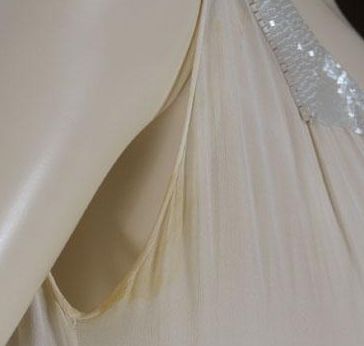
Underarm Stains on Vintage Garments
Good vintage sellers always show the condition of garment underarms as in this minor problem here in an otherwise lovely 1920's dress with beautiful beading.Image right courtesy of www.contentmentfarmantiques.com/ Lucky vintage collectors may find a dress with dress shields. We always used to sew these detachable underarm cotton inserts into wool and silk dresses to prolong their wear and reduce the cost of constant dry cleaning in the sixties. Removing someone else's dress shield may be unpleasant, but it may well have protected the dress brilliantly from damage. Excess perspiration left on a fabric can speed up the rotting process particularly on weighted silks where the metal salts such as those used in tin weighting, react with the chemicals in an antiperspirant and often create weakness or colour damage.
Rust Stains
Lemon juice mixed with common household salt creates Oxalic Acid the traditional, but poisonous proprietary remover for rust stains. Commercial products like Zud also work on rust.Mildew
...(v4r)
Mildew can spoil the look of any item and frankly it's best not to buy smelly goods or items with mildew. However if you have something with mildew on it, begin by putting it in the fresh air outside and letting sunlight get to it. This at least often removes the odour. Sometimes the mildew is so ingrained nothing will improve it, but fresh air and sunlight gives you a good basis to work from with specific laundering methods.
If the items are in fabrics that do not demand dry cleaning then you can use various products to deal with mildew. If possible try to kill the mildew as it can reappear. Products like half water mixed with lemon juice or white vinegar when sprayed on the item kill it. Lysol is available both as a spray or a wash product and gives good results on linen and on cotton. For mildew on leather use saddle soap and then mink oil to recondition as indicated below. On minimal mildew on small items like leather gloves, try the lemon juice or white vinegar method.
Leather Jackets
Leather jackets and worship of James Dean and Marlon Brando were all part of growing up if you were a teen in the 1950s and 60s. There is a good trade in fifties leather jackets and flying jackets today. However a true fifties leather jacket you might purchase or happen along in a car boot sale, might be in need of some tender loving care.
A jacket that is drying out will need to be treated either by you or a specialist leather restorer. Use saddle soap from a pet shop or equestrian dealer to clean it, applying the saddle soap according to the label instructions. Completely dry and buff the leather and then use mink oil to condition the leather. You must condition the leather if you have cleaned with the saddle soap otherwise you have done half a job and will create even more drying out problems as the saddle soap removes not only dirt, but also leather oils.
Applying the mink oil is an important and essential stage of restoring the leather. Rub the mink oil into the leather using the natural warmth of your hand to work it into the leather with a massage movement. Do this when you know you have time to clean the oil residue off, as leaving the oil on the leather for days will simply leave a wax like slick all over the leather. You must wipe off all excess mink oil with a clean dry cloth and buff the leather really well. Don't start this task until you have the time to spare to follow through every stage properly.
You could also use Pecard's leather conditioner to improve it. Pecards have a whole range of leather products just for motorcycle users and some contain mink oil. Nikwax is also a water based treatment that can restore dried out leather and make it more supple again. A product called Leather Amore also works well. Blackrock Leather 'N' Rich is another proven leather cleaner and conditioner. Plenty of commercial choice is available, so restoration of vintage leather is usually feasible.
Once the garment is restored to its previous glory, store it on a padded hanger and give it the six monthly treatment with a leather conditioner. With care like this, a vintage or new garment can last for many years.
Insect Control
Use freezing as a method of insect control for bugs such as moths. Put the item in a clean polythene bag, vacuum out excess air without crushing the item and seal the bag with a good duct tape or if it has one a self healing zipper. This helps prevent condensation which might add to your difficulties. Leave the bag in a chest freezer (not a domestic fridge freezer) for about a week at least without opening the door. The temperature should be about -5 to -12F. Thaw the package thoroughly - don't panic when you see condensation on the outside of the bag. Carefully inspect the item and check all bugs are dead, if not, repeat the process and finally dislodge all debris from the fabric by vacuuming carefully.Testing for True Bakelite
Bakelite was used in buttons, buckles and bags. Real bakelite is more valuable than plastic which looks similar. The best test for this is the simplest test of all if you are not at home. Rub your finger over the plastic until some friction occurs and it gets hot. Smell the plastic and if it is Bakelite it will have a distinctive odour of carbolic acid. A similar test that you can do at home is to run some hot water over the item and again the distinctive smell will almost overpower you. Bakelite also feels denser and heavier than other plastics as well as having a heavy sound when tapped. Read more about products that used bakelite in the 50's vintage tips section.Final Thoughts on Cleaning
Do not store vintage goods or wedding dresses in vacuum packed bags as creases will permanently set. You may instead consider using a textile preservation system such as that offered by Heritage Garment Preservation who also have excellent tips on storing treasured gowns.N.B Disclaimer
We take no responsibility for your careless use of electrical equipment which results in harm to you or others. Nor do we take any responsibility for any damage you may cause to your goods should you use any of the methods described here to renovate vintage goods."
These are some wonderful ideas/ways to gently bring your vintage clothing back to life, be sure to go to their website as well for more tips on preserving vintage items. My personal favorite cleaning product is Oxy-Clean. I have removed some of the worst stains/smells from vintage clothing that I thought I would have to trash.
And now, a personal story (not one I'm proud of):
Last month I was on the search for more vintage clothing---it's not like I don't have hundreds' of items already but my lust for vintage clothes over came me. I found an estate sale in a 'almost near' city and set out early one Saturday morning determined to fill my van with lots of treasures. Got there and noticed it was an older home---the hairs on the back of my neck started dancing with glee. After all, everyone knows the best vintage treasures are found in vintage homes!! I immediately asked the estate co. were the advertised clothing was and headed right to them. First indication I should have turned around and left--all the clothing was out under a carport which had been 'tarped' to keep the rain out. I began searching thru the smelly apparel (Second sign I should have 'hit the road') and there were some wonderful, timeless fashions. Well, I thought they looked timeless but the lighting was very poor in there(Third indicator I needed to keep my checkbook closed!). I grabbed my pile--again, without looking closely, took it to the checkout and made my deal. I happily drove home, confident my hoard was of the highest quality.
Got them home and immediately began to clean the odiferous items (remember sign #2). Some were able to go in the washing machine on gentle cycle and some I soaked in Oxy-Clean in my bath tub. I had done this many times before and just KNEW it would work again.
After a time I checked the washing machine to see the progress of my treasures. Opened the lid to find-----shedded clothing!! There were bits and pieces of dresses, jackets, pants and more all sitting in my machine, unrecognizable as clothing. I let the machine finish it's cycle (why stop it now, the damage was done) and threw the semi-wet lump of threads into the trash. With a gasp I remembered the four gowns I was soaking in my tub and ran to my bathroom. I sighed as all looked well as I reached down to gently agitate the frocks----and came up with a handful of shredded mush!!
I think it was around that time when I realized I hadn't inspected any of my treasures before purchasing them, that they had been in a damp, dark and semi-open carport and they SMELLED---please don't judge, sometimes I'm a slow learner.
The ending of this story is I lost about half of my wayward purchase and I learned that I MUST control my 'enthusiasm' when it comes to vintage clothes especially when it makes me forget good sense. The good news is I paid very little for my bulk so my financial loss was minimal.
Well, that's all I've got for now, please be sure to follow my blog and leave me a comment if you can---I would love to hear from you!
Till next time, God Bless all and any who read this,
Pat, My Kitschy Closet
Friday, April 1, 2016
An Ending and a Beginning - New Adventures on the horizon!
My son Jonathan and I have had a permanent shop at a monthly trade days now for almost 8 yrs. It's called Winnie Trade Days in Winnie, Tx and was quite a show in it's hay-day. I've actually talked about it in one of my previous posts - Did you know I have a shop?!?! We change it around constantly, moving stuff from one side of the shop to the other. Here's how it looked a few months ago:


We've gone through many transformations and locations over the years. From a small porch location to a full sized 'big' shop, over to a little one-room house and then to our current location, my sweet little 'half-shop'. We've enjoyed most locations and always loved our 'neighbor vendors/friends' and the joy they brought to us.
It is with some sadness and great excitement that I announce we are closing our sweet shop next weekend, April 8th - 10th. It will be our last show at Winnie and we would like to invite everyone to come out, tell us good-bye and maybe find a discounted treasure or two!
We are looking forward to many new, great adventures and we'll be sharing more about those soon---and remember, where there is an ending, there will also be a beginning!
God Bless all and any who read this,
Pat, My Kitschy Closet
www.mykitschycloset.etsy.com


We've gone through many transformations and locations over the years. From a small porch location to a full sized 'big' shop, over to a little one-room house and then to our current location, my sweet little 'half-shop'. We've enjoyed most locations and always loved our 'neighbor vendors/friends' and the joy they brought to us.
It is with some sadness and great excitement that I announce we are closing our sweet shop next weekend, April 8th - 10th. It will be our last show at Winnie and we would like to invite everyone to come out, tell us good-bye and maybe find a discounted treasure or two!
We are looking forward to many new, great adventures and we'll be sharing more about those soon---and remember, where there is an ending, there will also be a beginning!
God Bless all and any who read this,
Pat, My Kitschy Closet
www.mykitschycloset.etsy.com
Tuesday, March 8, 2016
Movin' and Groovin' cause that's my style!!
When anyone asks me how I'm doing, I have a habit of saying "I'm movin' & groovin'". Not sure why/when I started doing that but I've found it usually brings a smile to the ask-er's face. AND, it's a very truthful statement---I am almost ALWAYS movin' & groovin' with some project, show or life event. It's slowing down that I have problems with---it has to do with my ADHD I'm sure. Sometimes I even have mild anxiety attacks and can't seem to focus on one task or another. God is helping me with this and I'll share more about that in a later post.
Here are a few pictures of this past weekends show at the Gypsy Market in Spring, TX.
Here are a few pictures of this past weekends show at the Gypsy Market in Spring, TX.
 |
| My Brayden, waiting patiently while I set up my booth--AND he was helping as well! |
 |
| It's an odd shaped booth but I think we managed to make it look bright and happy |
 |
| Some of those teddy bears went home with someone else! |
 |
| Mardi Gras on steroids?!?!
Our next show will be at our shop in Winnie Tx. We've got BIG news coming about that event, but I'll save that for another post!!
God Bless All and Any who read this,
Pat, My Kitschy Closet
|
Friday, January 15, 2016
Welcome to the 70's!!
I thought it was time for another 'blast from the past' post where we explore a past fashion era and all the great and not-so-great looks, so.......Welcome to the 70's!!! This is probably my favorite era for fashion and music---gotta love that disco! It was the birth of the Farrah Fawcett hair-style, the wide legged pants and 'Ziggy Stardust', David Bowie's alter ego. It was a great time for colors, crazy hair, high-waisted pants and denim!!!

Please read this great article from www.vintagefashionguild.org
The 1970s can be called Decade of Decadence, the ‘Me’ decade and the decade of excess and androgyny. Women emerged in the work place tenfold. Pantsuits, day wear, and separates with a sense of masculine style as echoed in the film ‘Annie Hall’ created a sensation with Diane Keaton wearing a fitted vest with a collared white shirt and men’s neckties. Skirts could be seen in a variety of lengths, mini midi or maxi! The maxi dress was worn throughout the decade in a multitude of styles and shapes. Rich earthy tones dominated in popular colors; warm browns, burgundy, rust, mustard, and avocado green. Television shows such as Charlie’s Angels featured the smart and liberated but sexy woman. The California sun-kissed blondes Cheryl Tiegs and Farrah Fawcett represented the new sporty and physically fit ideal.
The Woodstock festival of peace and music was the end of the 1960s hippie movement, with the U.S. still at war. The hippie flower child look from the late 1960s carried over into the first half of the decade in a nonrestrictive bohemian silhouette with a heavy folksy influence. Thea Porter celebrated ethnic styles in Indian style prints, free flowing breezy gauzy tent dresses and wide legged pants. Arts and crafts elements such as tie-dye, batik, knitwear, crochet and macramé were also very popular. There was a great sense of ease and comfort to early 1970s clothing. Designers like Laura Ashley and Jessica McClintock for Gunne Sax popularized the prairie dress phenomenon.
Blue jeans emerged in the 1970s as everyday wear. Denim was being mass consumed by all ages and seen as the ultimate American garment. Jeans were flared, bell bottom, wide legged, hip huggers, high waist, embroidered, embellished, studded – you name it! Denim was was not just limited to pants: jean skirts, suits, vests, jackets, hats and accessories were omnipresent. Designer jeans were seen as a status symbol and the more expensive, the more desirable! A tighter, second skin fit with designer names such as Gloria Vanderbilt, Calvin Klein, Jordache, and Sasson were branded across the backsides of men and women everywhere. A far cry from the dungarees of years past!
Glam or glitter rock brought on to the scene flamboyant boldly colored clothes in lux fabrics like satins, velvets and lurex. Emblazoned with sequins, bedazzled, gemmed and worn with feathered boas! Nothing was too outrageous. Super high stacked platform shoes or boots were the favored footwear. Pop star David Bowie, as alter ego Ziggy Stardust, sported over-the-top androgynous outfits both on and off the stage. Avant garde designer Kensai Yamamoto was responsible for the otherworldly costumes for the 1973 ‘Aladdin Sane’ tour. Glitter rock stars of the the time such as Kiss, Marc Bolan, The Sweet and the New York Dolls were dandy dressers in chiffon, spandex and satin. Glitter trends in makeup were worn on the face by both men and women. Stores such as Granny Takes a Trip and Biba had multiple locations in the U.S. and the U.K that catered to the teenage audience and rock stars alike.
Disco brought excess and decadence. Designers and celebrities partied with the beautiful people at the infamous nightclub Studio 54 in New York City known for its overt drug use and bacchanalian carousing. Bob Mackie was often called the ‘Sultan of Sequins’ and dressed Cher and other stars in body-baring glamorous costumes. Designer Roy Halston’s draped jersey goddess dresses, kaftans and Ultrasuede were the perfect party clothes for a glamorous night of sin. Quiana polyester was wildly popular and was used in day dresses, shirts, blouses and evening wear. Cheaply made tight fitting body conscious clothing could be seen in any discotheque. Wrap-around skirts, leotards, tube tops, dance wear inspired dresses and separates with ease and movement were made in Lurex, miliskin and spandex. Film star John Travolta wore a white 3-piece suit with black shirt in the blockbuster movie “Saturday Night Fever”. Diane Von Fursternberg popularized the uber flattering jersey wrap dress, which became a staple in every woman’s wardrobe.
Punk fashion evolved alongside the musical genre out of open disgust for the status quo, the modern political agenda and the slick overproduced overtly commercial mainstream that rock music had become. Punk rock stripped rock and roll down to basics. Punk was gritty, dangerous and offensive. The clothing represented a darker and harsher view of reality and dissatisfaction with the ideals of conformity.
English punk visionaries Vivienne Westwood and Malcolm McLaren opened the infamous shop SEX/ Seditionaries on Kings Road and ultimately deconstructed British fashion, mixing X-rated silk screens, bondage gear, vinyl, rubber and the ubiquitous safety pin with iconic English fashions such as plaid kilts and tight stovepipe trousers
Across the pond the American punk look was stripped down to basics, exemplified by bands like the Ramones, Blondie, and Richard Hell and the Voidoids preferring a more laid back look with tight jeans,
leather motorcycle jackets, sneakers, and ripped t-shirts.

Please read this great article from www.vintagefashionguild.org
The 1970s can be called Decade of Decadence, the ‘Me’ decade and the decade of excess and androgyny. Women emerged in the work place tenfold. Pantsuits, day wear, and separates with a sense of masculine style as echoed in the film ‘Annie Hall’ created a sensation with Diane Keaton wearing a fitted vest with a collared white shirt and men’s neckties. Skirts could be seen in a variety of lengths, mini midi or maxi! The maxi dress was worn throughout the decade in a multitude of styles and shapes. Rich earthy tones dominated in popular colors; warm browns, burgundy, rust, mustard, and avocado green. Television shows such as Charlie’s Angels featured the smart and liberated but sexy woman. The California sun-kissed blondes Cheryl Tiegs and Farrah Fawcett represented the new sporty and physically fit ideal.
The Woodstock festival of peace and music was the end of the 1960s hippie movement, with the U.S. still at war. The hippie flower child look from the late 1960s carried over into the first half of the decade in a nonrestrictive bohemian silhouette with a heavy folksy influence. Thea Porter celebrated ethnic styles in Indian style prints, free flowing breezy gauzy tent dresses and wide legged pants. Arts and crafts elements such as tie-dye, batik, knitwear, crochet and macramé were also very popular. There was a great sense of ease and comfort to early 1970s clothing. Designers like Laura Ashley and Jessica McClintock for Gunne Sax popularized the prairie dress phenomenon.
Blue jeans emerged in the 1970s as everyday wear. Denim was being mass consumed by all ages and seen as the ultimate American garment. Jeans were flared, bell bottom, wide legged, hip huggers, high waist, embroidered, embellished, studded – you name it! Denim was was not just limited to pants: jean skirts, suits, vests, jackets, hats and accessories were omnipresent. Designer jeans were seen as a status symbol and the more expensive, the more desirable! A tighter, second skin fit with designer names such as Gloria Vanderbilt, Calvin Klein, Jordache, and Sasson were branded across the backsides of men and women everywhere. A far cry from the dungarees of years past!
Glam or glitter rock brought on to the scene flamboyant boldly colored clothes in lux fabrics like satins, velvets and lurex. Emblazoned with sequins, bedazzled, gemmed and worn with feathered boas! Nothing was too outrageous. Super high stacked platform shoes or boots were the favored footwear. Pop star David Bowie, as alter ego Ziggy Stardust, sported over-the-top androgynous outfits both on and off the stage. Avant garde designer Kensai Yamamoto was responsible for the otherworldly costumes for the 1973 ‘Aladdin Sane’ tour. Glitter rock stars of the the time such as Kiss, Marc Bolan, The Sweet and the New York Dolls were dandy dressers in chiffon, spandex and satin. Glitter trends in makeup were worn on the face by both men and women. Stores such as Granny Takes a Trip and Biba had multiple locations in the U.S. and the U.K that catered to the teenage audience and rock stars alike.
Disco brought excess and decadence. Designers and celebrities partied with the beautiful people at the infamous nightclub Studio 54 in New York City known for its overt drug use and bacchanalian carousing. Bob Mackie was often called the ‘Sultan of Sequins’ and dressed Cher and other stars in body-baring glamorous costumes. Designer Roy Halston’s draped jersey goddess dresses, kaftans and Ultrasuede were the perfect party clothes for a glamorous night of sin. Quiana polyester was wildly popular and was used in day dresses, shirts, blouses and evening wear. Cheaply made tight fitting body conscious clothing could be seen in any discotheque. Wrap-around skirts, leotards, tube tops, dance wear inspired dresses and separates with ease and movement were made in Lurex, miliskin and spandex. Film star John Travolta wore a white 3-piece suit with black shirt in the blockbuster movie “Saturday Night Fever”. Diane Von Fursternberg popularized the uber flattering jersey wrap dress, which became a staple in every woman’s wardrobe.
Punk fashion evolved alongside the musical genre out of open disgust for the status quo, the modern political agenda and the slick overproduced overtly commercial mainstream that rock music had become. Punk rock stripped rock and roll down to basics. Punk was gritty, dangerous and offensive. The clothing represented a darker and harsher view of reality and dissatisfaction with the ideals of conformity.
English punk visionaries Vivienne Westwood and Malcolm McLaren opened the infamous shop SEX/ Seditionaries on Kings Road and ultimately deconstructed British fashion, mixing X-rated silk screens, bondage gear, vinyl, rubber and the ubiquitous safety pin with iconic English fashions such as plaid kilts and tight stovepipe trousers
Across the pond the American punk look was stripped down to basics, exemplified by bands like the Ramones, Blondie, and Richard Hell and the Voidoids preferring a more laid back look with tight jeans,
leather motorcycle jackets, sneakers, and ripped t-shirts.
 |
| Wow, a grown-up Brady Brunch!! |
 |
| Uhmmm, ladies fashion looks good, not too sure about the men's--what do you think? |
 |
| I had one very similar to this! |
 |
| This is a leftover look from the 60's I believe--think "Billy Jack" |
 |
| I have no words for this one |
 |
| These guys produced some GREAT music!! |
 |
| Saturday Night Fever made EVERYONE want to go to the disco!! |
 |
| Again, I have no words..... |
 |
| These guys were the best---I miss Michael |
 |
| Wanted one of these back in the day, still do! |
 |
| I know I had a pair of earrings very much like these! |
 |
| Mine were white! |
 |
| I still have lots of brooches from the 70's--they never go out of style! |
 |
| ??? |
 |
| I have this necklace and earrings!!! |
 |
| Beautiful! |
 |
| David Bowie was definitely a trend-setter |
 |
| Again, ???? |
 |
| Ziggy |
 |
| We will miss you David, you were unique!
Hope you enjoyed this little return to the 70's---please leave me a comment and let me know your favorite era!! Until then, God Bless all and any who read this, Pat, My Kitschy Closet www.mykitschycloset.etsy.com
|
Monday, January 11, 2016
CRAZY Busy Schedule!!
Ok, so for those of you who don't really know me, the following schedule is normal for me:
January 8-10-Winnie Trade Days (just passed this last weekend)
January 16 - Winter Wonderland Fashion Show - (my grandson
Brayden is modeling in this one!)
January 22-24 - Liberty Faux Real Trade Days
January 29th - 30th - TENATIVE - holding an estate sale at my
mom's house
February 5 - 7 - Winnie Trade Days
February 20 - 21 - Antique Elegance Vintage Clothing Show-Dallas, TX
March 3-5 - Gypsy Market, Spring, TX
March 11-13 - Winnie Trade Days
March 19 - Good Oil Days Festival (I actually run this one!)
There's actually more but I got tired just typing it all!! These are all great events and if you're in the area or there-bout's please come check them out---here are the links to each event.
Winnie Trade Days - www.larrysoldtimetradedays.com
Winter Wonderland Fashion Show - www.humblecc.com
Liberty Faux Real Trade Days - www.facebook.com/FauxRealDesignCo/
Antique Elegance Vintage Clothing Show -http://antiqueelegance.info/
Gypsy Market - www.gypsymarket.net
Good Oil Days Festival - www.goodoildays.com

As you can see, I've got a VERY full schedule over the next few months!! But I do sooooo love going to shows and meeting new people--and hopefully making some money too!
Please be sure to check out all these great websites and come by and see me if you're in the neighborhood! ;)
Until then,
God Bless all and any who read this,
Pat, My Kitschy Closet
www.mykitschycloset.etsy.com
January 8-10-Winnie Trade Days (just passed this last weekend)
January 16 - Winter Wonderland Fashion Show - (my grandson
Brayden is modeling in this one!)
January 22-24 - Liberty Faux Real Trade Days
January 29th - 30th - TENATIVE - holding an estate sale at my
mom's house
February 5 - 7 - Winnie Trade Days
February 20 - 21 - Antique Elegance Vintage Clothing Show-Dallas, TX
March 3-5 - Gypsy Market, Spring, TX
March 11-13 - Winnie Trade Days
March 19 - Good Oil Days Festival (I actually run this one!)
There's actually more but I got tired just typing it all!! These are all great events and if you're in the area or there-bout's please come check them out---here are the links to each event.
Winnie Trade Days - www.larrysoldtimetradedays.com
Winter Wonderland Fashion Show - www.humblecc.com
Liberty Faux Real Trade Days - www.facebook.com/FauxRealDesignCo/
Antique Elegance Vintage Clothing Show -http://antiqueelegance.info/
Gypsy Market - www.gypsymarket.net
Good Oil Days Festival - www.goodoildays.com
 |
| Lots of this stuff will be packed and taken to other shows--aagggghhhhhh! |

 |
| Brayden's 'soulful' look--guest he's practicing for his modeling debut!! |
As you can see, I've got a VERY full schedule over the next few months!! But I do sooooo love going to shows and meeting new people--and hopefully making some money too!
Please be sure to check out all these great websites and come by and see me if you're in the neighborhood! ;)
Until then,
God Bless all and any who read this,
Pat, My Kitschy Closet
www.mykitschycloset.etsy.com
Tuesday, January 5, 2016
Take down the Mistle Toe, put the Tree in the Attic!
I'm always a little sad right after Christmas---especially when taking down the Christmas tree, lights and decorations. The Christmas season is usually such a joyful time, even for those who aren't particularly religious. It's a time when almost everyone begins to think of those around them, those folks that might not be as fortunate as they are. It's a time when we open our hearts (and maybe our pocketbooks) to make someone's Christmas more joyful. Beautiful!
And of course, who doesn't love all the millions of twinkle lights that we put up to 'brighten' our homes and the hearts of our neighbors!! It's a Christmas tradition to try to blind your neighbors and the airplanes that fly over your house with as many lights as possible!! Too cool!
And of course, who doesn't love all the millions of twinkle lights that we put up to 'brighten' our homes and the hearts of our neighbors!! It's a Christmas tradition to try to blind your neighbors and the airplanes that fly over your house with as many lights as possible!! Too cool!
 |
| My own special vintage 'elf' |
 |
| I LOVE my aluminum tree--not vintage though |
 |
| A wonderful vintage nativity from the 50's I think |
 |
| Christmas cheer on my mantel |
And so, the lovely Christmas season is over and the new year has begun!! And boy, do we have lots of PLANS afoot!! Planning on participating in many wonderful shows with my vintage clothes as well as shows for the antiques and collectibles from my shop. I'll be posting my show schedule very soon and hopefully you're be able to stop by and say 'hello'!!
In the meantime, our prayer for each and everyone of you is that you would be blessed in this new year, that you will find purpose and joy in your life and that your creativity will flourish and overflow to all those around you!!
I'll be posting again soon!
God Bless,
Pat, My Kitschy Closet
www.mykitschycloset.etsy.com
In the meantime, our prayer for each and everyone of you is that you would be blessed in this new year, that you will find purpose and joy in your life and that your creativity will flourish and overflow to all those around you!!
I'll be posting again soon!
God Bless,
Pat, My Kitschy Closet
www.mykitschycloset.etsy.com
Subscribe to:
Comments (Atom)